
Google Ads New Zealand

India-based Google Ads agency for New Zealand businesses.

New Zealand paid search is a small-volume market, and almost every practical decision follows from that. Keyword lists that would be considered tightly segmented in a larger country will not gather enough data here to be read reliably, match types behave differently, and automated bidding needs more conversion history than a thin account can supply. WIF builds NZ accounts around that constraint rather than importing a structure designed for a bigger market.

Campaign focus

At New Zealand scale, over-segmenting an account does more damage than under-segmenting it.

The instinct carried over from larger markets is to split campaigns by keyword theme, city and device until everything is isolated. In New Zealand that usually produces a set of ad groups too sparse to optimise, and an automated bidding strategy with nothing to learn from. The structural question here is what to combine, not what to separate.

Volume reality

Keyword strategy has to work with a thin query pool.

A national New Zealand campaign competes for a fraction of the query volume an equivalent Australian or UK campaign would see. That changes the job. Rather than harvesting long-tail variants that may never accumulate enough impressions to evaluate, the account concentrates on the core commercial terms and keeps enough breadth to capture phrasing nobody predicted. Consolidation is a deliberate tactic here, not laziness.
Match types

Exact-only structures often starve a New Zealand account.

Locking everything to exact match is a reasonable instinct for spend control and a common way to strangle an NZ campaign. Too little traffic reaches the account, bidding never leaves the learning phase, and genuine buyers phrasing things unusually are never seen. The workable approach is broader matching paired with an actively maintained negative list and frequent search-term review, so the account stays open to demand while the query report does the filtering.

NZD budgets

A modest NZD budget is better concentrated than distributed.

Spreading a small budget across many campaigns produces several datasets, none conclusive. It is usually more effective to run fewer campaigns with enough daily budget to clear the learning threshold and generate a readable weekly signal, then widen once the core is stable. WIF sets budgets against what will produce a decision, and is explicit when the current allocation cannot support the structure someone has asked for.

Geography

National targeting is usually the right default here.

Population concentrates heavily in Auckland, with Wellington and Christchurch as the other main centres and the remainder spread thinly. For most advertisers, splitting these into separate campaigns from the start fragments already-limited data. National targeting with location reporting layered on top gives the same regional insight without dividing the account. City-level campaigns are worth building when a centre proves it needs distinct bids, messaging or budget, and not before.

Claim substantiation

The Fair Trading Act applies to search ad copy.

New Zealand's Fair Trading Act prohibits misleading and deceptive conduct in trade, and a search ad headline is subject to it like any other representation. Comparative claims, "best" and "cheapest" language, pricing statements and guarantees all need a basis the business can produce if challenged. WIF reviews copy for claims that cannot be evidenced and replaces them with specifics, which tend to convert better than superlatives regardless.

Tracking

Small conversion counts make tracking errors expensive.

When an account produces a modest number of conversions per month, a duplicated tag or a mis-scoped event distorts the entire picture and there is not enough volume for the error to average out. Conversion setup deserves more scrutiny in a small market, not less. Forms, calls, UTM fields and CRM statuses are checked as one path before any budget conclusion is drawn from them.

Process

How WIF starts a New Zealand Google Ads audit.

The first question in an NZ account is almost always whether it has enough data to support the structure it has been given. Many of the problems presented as targeting or bidding failures turn out to be sample-size problems wearing a different label.

  • Assess whether campaign and ad group count is proportionate to actual conversion volume.
  • Review match types, search terms and negative coverage for over-restriction as well as waste.
  • Check whether bidding strategies have the conversion history they require to function.
  • Review location settings and whether main-centre splits are earning their fragmentation cost.
  • Validate conversion events carefully, since small counts magnify tracking errors.
  • Read ad copy against Fair Trading Act substantiation expectations.
  • Map keywords to landing-page message match and NZ buyer language.
  • Prioritise consolidation and tracking fixes before adding budget or campaign types.
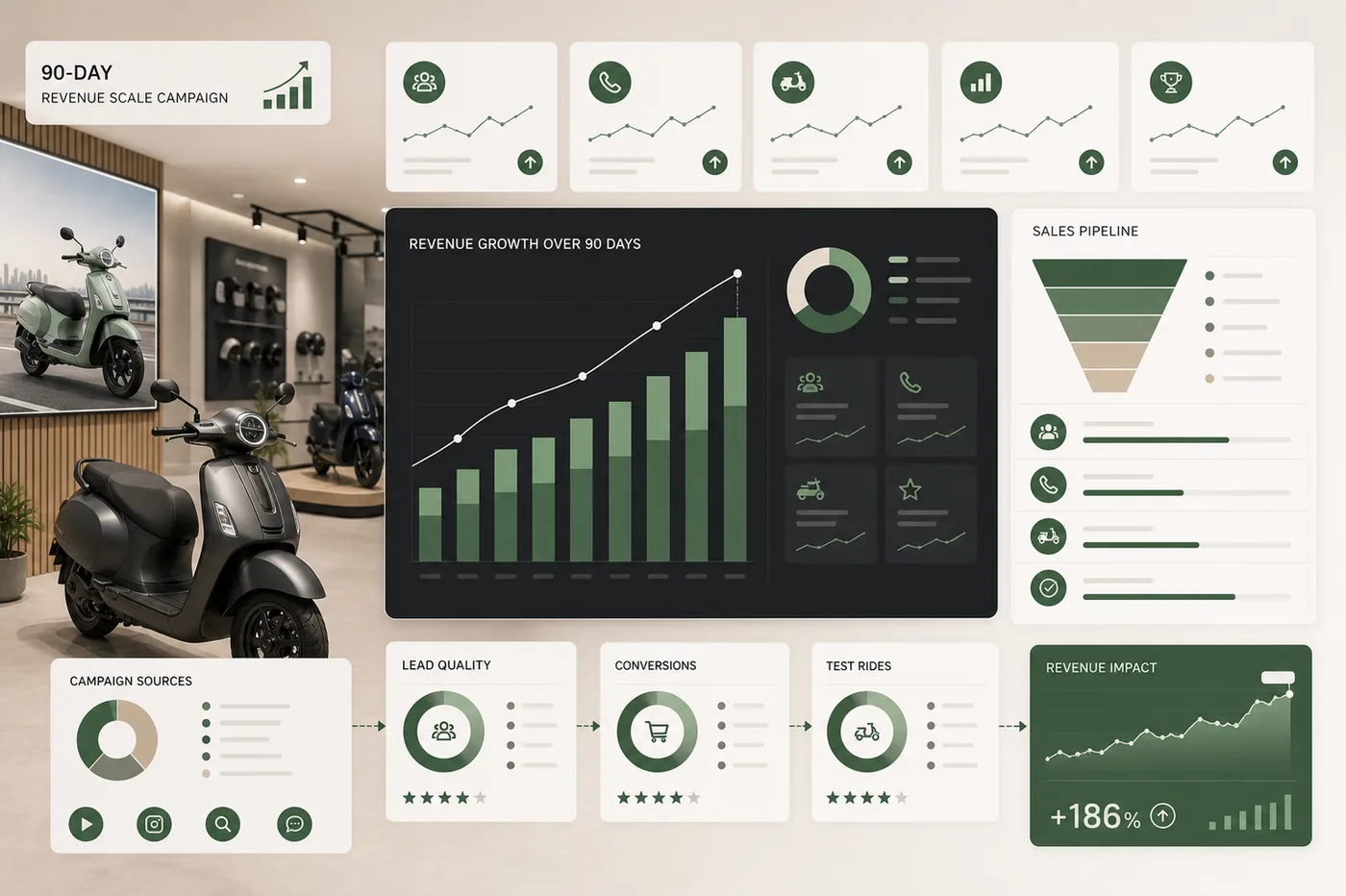
Revenue scale campaign visual Related proof Rs. 5 Cr+

Proof and context

WIF ties paid acquisition to conversion and follow-up systems.

These cases come from a much larger market and are directional evidence of method, not a projection for New Zealand. Volume, competition and cost all differ. The transferable part is the discipline of reading the search-term report properly, keeping structure proportionate to data, and letting sales feedback rather than platform conversions direct budget.

  • Bajaj Chetak: Rs. 5 Cr+ reported revenue in 90 days.
  • Bajaj Chetak: 800+ EV leads at 18.75% reported conversion rate.
  • Workflow automation: cleaner lead routing and response workflows.

FAQ

Questions about Google Ads for New Zealand businesses.

Yes. WIF can support New Zealand-facing Google Ads accounts with search campaign structure, conversion tracking, landing-page review and lead-quality reporting.

Substantially. Structures that work in larger markets often split an NZ account into segments too small to evaluate or to feed automated bidding. The usual correction is consolidation: fewer campaigns, each carrying enough traffic and conversion history to produce a signal worth acting on.

Rarely. Exact-only structures feel safe but often restrict an NZ account until it cannot gather enough data to optimise. Broader matching with a well-maintained negative list and regular search-term review generally works better, because the query report filters demand instead of the keyword list blocking it upfront.

National targeting is usually the better starting point. Population concentrates in Auckland with Wellington and Christchurch behind it, and splitting the main centres early fragments limited data. Location reporting gives the regional view without dividing the account; separate city campaigns come once a centre demonstrably needs its own bids or messaging.

Yes. It prohibits misleading and deceptive conduct in trade, and that covers search ad copy. Comparative claims, superlatives, pricing statements and guarantees need a basis the business can produce. WIF flags claims that cannot be evidenced; anything contentious should be confirmed with the client's legal adviser.

WIF reviews search terms, match types, negative keywords, page match, conversion events, lead quality and follow-up before moving budget.

Free growth audit

Audit the New Zealand Google Ads funnel before adding spend.