The campaign needed to move from visible leads into revenue-backed marketing decisions.
This is the commercial problem the work had to respect.

Case study
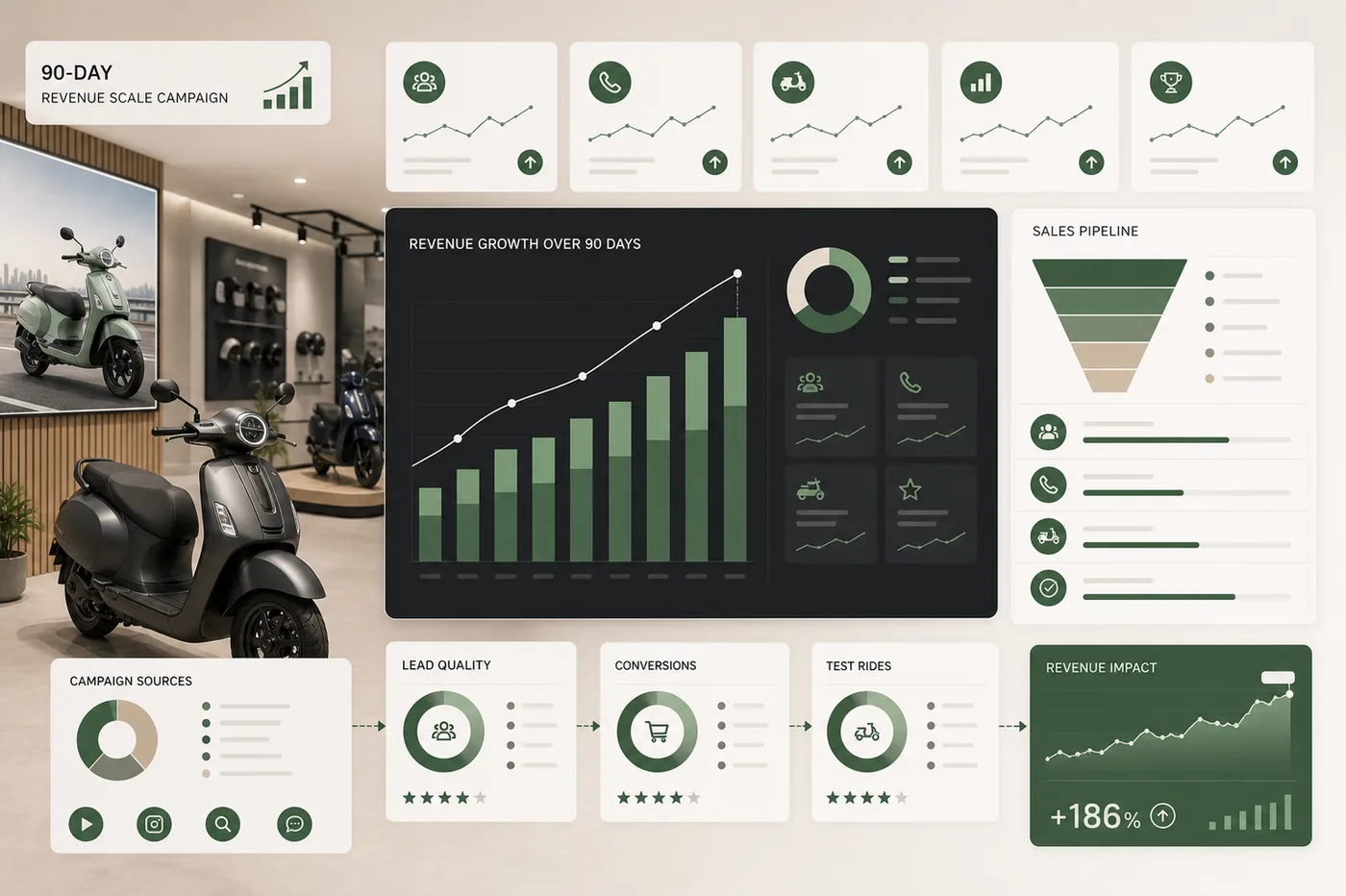
This case gives the Bajaj Chetak story its commercial layer: lead generation was connected to reported revenue movement, not only form volume.
Case answer
A useful case study should explain the business context, the operating focus and the lesson a buyer can take into their own funnel.
This is the commercial problem the work had to respect.
This is the part of the growth system WIF focused on improving.
This is the practical takeaway, not a guarantee of the same result.
Method
Read the case as a decision framework, not a guarantee. The same moves only matter when the market, offer, sales process and data quality are comparable.
 Case result
Rs. 5 Cr+
Case result
Rs. 5 Cr+
Reported proof
The same EV acquisition system moved from lead volume into reported revenue performance, with current site data reporting Rs. 5 Cr+ in 90 days.
FAQ
It gives directional proof of how WIF thinks through campaigns, pages, tracking and follow-up. Results depend on market, offer, budget and sales execution.
WIF reviews useful signals such as qualified leads, conversion quality, source context, sales feedback and revenue movement instead of relying only on impressions or clicks.
Yes. The operating model stays similar, but market language, targeting, proof, budget and follow-up rules are adjusted for the buyer and location.
Free growth audit